


Last Updated: August 26, 2026
You notice water dripping from a small pipe outside the house. It might only be a few drops at first, so it is easy to ignore.
But if an overflow pipe is dripping, there is normally a reason for it.
In many Dublin homes, the problem comes from a water storage tank or cistern filling higher than it should. A faulty or poorly adjusted float valve is one of the common causes. If the water keeps running or you cannot identify where it is coming from, it is worth having a plumber in Dublin check the system before the problem gets worse.
The overflow pipe then does exactly what it is there to do: it gives excess water somewhere to escape instead of allowing the tank to overflow inside your home.
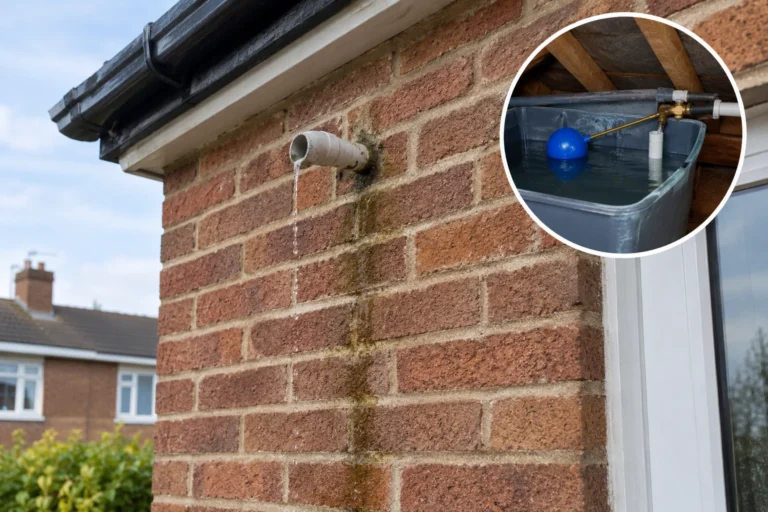
What Is an Overflow Pipe?
An overflow pipe provides a safe route for excess water to leave a tank or cistern.
Think of it as a warning pipe.
Normally, the water inside a tank should stop filling before it reaches the overflow. If the water keeps rising, it reaches the overflow outlet and is carried safely outside.
That is why seeing water coming from it shouldn’t simply be treated as an annoying drip.
The overflow pipe may be working correctly. The question is why water is reaching it in the first place.
Depending on the plumbing system in your home, an external overflow can be associated with a cold-water storage tank, a smaller heating feed and expansion tank, or an older-style toilet cistern.
Some modern toilet cisterns use an internal overflow instead, meaning excess water runs into the toilet bowl rather than through a separate pipe outside.
Why Is My Overflow Pipe Dripping?
The most common reason is fairly simple: a tank or cistern is continuing to fill when it should have stopped.
A float valve controls the incoming water.
As the water rises, the float rises with it. Once the correct level is reached, the valve should close and stop more water entering.
If that doesn’t happen, the water continues rising until it reaches the overflow.
A faulty float valve is one of the most common causes, but it isn’t the only possibility.
1. Faulty Float Valve or Ball Valve
This is one of the first things a plumber will consider.
You might also hear it called a ballcock or ball valve, particularly on older plumbing systems.
The valve can fail to shut off properly because it is worn, damaged, sticking or incorrectly adjusted.
Instead of stopping at the normal water level, the tank continues filling.
Eventually:
water level rises → reaches overflow → water runs outside
Sometimes it produces a slow drip. In other cases, you may see a steady stream of water.
2. Float Set Too High
The valve doesn’t always need to be completely broken.
If the float is adjusted too high, the water may reach the overflow before the inlet valve closes properly.
This can sometimes happen after work has been carried out on the tank or valve.
The important part is getting the water level and valve operation checked rather than trying to stop the water at the overflow pipe itself.
3. Worn Washer or Internal Valve Parts
Older float valves contain components that wear over time.
A worn washer or valve may no longer form a proper seal when the float reaches its shut-off position.
You may then hear the tank quietly continuing to fill even though nobody in the house is using water.
Uisce Éireann suggests listening for a storage tank refilling when no water-using appliances have been used and a toilet hasn’t recently been flushed. This can be a useful clue that something isn’t operating normally.
4. The Float Is Sticking
Sometimes the float cannot move freely.
It may catch against the side of the tank, become damaged or fail to rise properly with the water.
If the float stays too low, the valve effectively thinks the tank still needs more water.
The tank keeps filling and the excess eventually reaches the overflow.
5. Toilet Cistern Filling Too High
Not every overflow pipe comes from the attic.
In homes with an externally piped toilet overflow, the water may be coming from a toilet cistern that isn’t shutting off correctly.
You may also notice:
- the toilet constantly refilling
- water running when nobody has flushed it
- a hissing or filling sound
- water sitting unusually high in the cistern
Modern toilets often send overflow water into the toilet bowl instead, so you may see a small but continuous stream running down the back of the bowl rather than water outside.
Uisce Éireann recommends checking for a constant sound of water or a stream running inside the toilet bowl when investigating household leaks.
6. A Problem With the Heating Feed and Expansion Tank
Some Dublin homes with open-vented heating systems have a smaller feed and expansion tank in the attic.
This shouldn’t be confused with the larger cold-water storage tank.
If the smaller tank is filling too high or overflowing, the cause needs to be identified correctly before anything is adjusted or replaced.
This is one reason why identifying which tank an overflow belongs to matters.
A plumber shouldn’t simply see water outside and replace the first ball valve they find. The source needs to be confirmed.
Which Overflow Pipe Is Dripping?
The position of the external pipe can give you a useful clue, but it isn’t enough on its own to diagnose the fault.
Overflow pipe high up on the house
A pipe exiting high on an outside wall or around attic level can point towards a tank in the attic.
In many traditional Irish plumbing systems, that may be the main cold-water storage tank or a smaller heating feed and expansion tank.
Uisce Éireann notes that domestic water storage tanks are usually located in the attic and specifically advises checking the external wall for signs of water from their overflow pipes.
Overflow pipe around bathroom level
Depending on the age and plumbing arrangement of the property, this may be connected to a toilet cistern.
Check whether the toilet is constantly filling or whether water continues running after the cistern should have stopped.
Not sure where it comes from?
Don’t assume.
Pipework can be altered over the years, particularly in older houses that have had bathrooms, heating systems or attic plumbing changed.
Tracing the pipe back to its source gives a much more reliable answer.
Is an Overflow Pipe Dripping an Emergency?
A small drip isn’t usually the same type of emergency as a burst pipe, but it shouldn’t be left indefinitely.
An occasional drip can develop into a constant flow if the valve continues deteriorating.
More importantly, the overflow is telling you that something isn’t controlling the water correctly.
Arrange to have it checked sooner if:
- the drip has become a steady stream
- the flow is getting worse
- the tank keeps filling continuously
- you can hear running water when nothing is being used
- water is appearing somewhere other than the overflow
- there are signs of water around the attic tank
- ceilings or walls are becoming damp
- you cannot identify where the water is coming from
If water is leaking inside the property, particularly near electrics, treat the situation more seriously.
For significant internal leaks, Uisce Éireann advises shutting off the water supply to limit damage. Its guidance also says not to touch a wet electrical switch and to use a qualified electrician where water is affecting electrical equipment.
Can I Stop an Overflow Pipe Dripping Myself?
There are a few basic checks you can make without dismantling the plumbing.
First, try to identify where the overflow originates.
If you can safely access the relevant tank or cistern, check whether the water level appears unusually high or whether water continues entering after it should have stopped.
You may also be able to hear the inlet continuing to run.
If you don’t know your plumbing system or you’re uncomfortable accessing an attic tank, leave the repair to a plumber.
Know where your stop valve is
It is worth knowing how to shut off your home’s water supply before you ever have a serious leak.
Uisce Éireann recommends knowing the location of your inside stop valve so water can be turned off quickly when necessary.
If you’re dealing with a significant leak and need guidance, see our guide to finding and turning off your stopcock.
Never Block or Cap a Dripping Overflow Pipe
This is important.
Do not solve the problem by plugging, capping or blocking the overflow outlet.
The water coming out is the symptom, not the underlying fault.
The pipe provides somewhere for excess water to escape. Blocking that route doesn’t fix the valve or stop the tank filling.
Instead, the source of the excess water needs to be found and repaired.
Overflow Pipe Dripping From an Attic Water Tank
This is particularly relevant in Dublin because many homes still have attic water storage.
If the pipe can be traced to the main cold-water storage tank, check whether the tank is filling when it shouldn’t be.
The problem may be with the float valve, but don’t automatically assume that’s the only possibility.
Look for other warning signs around the tank as well:
- water level unusually high
- constant filling noise
- dampness around the tank
- water marks
- damaged fittings
- corrosion on older pipework
- signs that water has escaped into the attic
If you’re seeing water around the tank itself rather than only through its overflow, that’s a different problem. See our guide to a water tank leaking in the attic for the causes and warning signs.
Does a Dripping Overflow Waste Much Water?
It can.
A few drops don’t look like much when you stand outside and watch them for ten seconds. But the problem may continue all day and night.
Uisce Éireann says checking and repairing household leaks can save up to 19,000 litres of water per year, although that figure covers household leaks generally rather than overflow pipes specifically.
So don’t judge the problem only by how small each individual drip looks.
A constantly filling tank is also a useful warning that water is being used somewhere when it shouldn’t be.
Why Has My Overflow Pipe Suddenly Started Dripping?
If it has been dry for years and suddenly starts dripping, something in the system has changed.
Often this is simply wear.
Float valves, washers and moving components don’t last forever. A valve that has worked properly for years can gradually stop closing completely.
A sudden problem can also follow plumbing work or adjustment to a tank or cistern.
The timing can give a plumber useful information, so mention whether the dripping started suddenly, gradually, or after recent work.
Why Does the Overflow Pipe Only Drip Sometimes?
Intermittent dripping can be harder to diagnose than a pipe that runs continuously.
Pay attention to when it happens.
For example:
Does it happen after using lots of hot water?
After the heating has been running?
After a toilet has been flushed?
Only overnight?
Does the tank seem to refill when nobody is using water?
Those details can help narrow down which part of the system is responsible.
Don’t assume that an intermittent overflow has fixed itself simply because the pipe becomes dry again.
Overflow Pipe Dripping in Older Dublin Homes
Older Dublin properties can have plumbing systems that have been altered several times over the years.
A house may have had a new bathroom, heating upgrade, cylinder replacement or partial replumbing while sections of the original pipework remain.
That can make tracing an unidentified overflow less straightforward than it looks from outside.
If you’re experiencing several plumbing problems together, such as poor pressure, ageing pipes or recurring faults, our guide to common plumbing problems in older Dublin homes explains what else to look for.
When Should You Call a Plumber?
If the overflow keeps dripping, the sensible approach is to have the underlying cause repaired rather than waiting for it to get worse.
A plumber can trace the pipe, check the water level, test the float valve and determine whether the problem is coming from a storage tank, cistern or heating-related component.
You should arrange a plumber sooner if the water is flowing continuously, the problem keeps returning, you find water inside the attic, or you’re unsure which system the pipe belongs to.
At Dublin Plumber 24 Hrs, we deal with household plumbing problems across Dublin, including overflowing tanks, faulty float valves, leaking cisterns and related water-supply issues.
You can see our plumbing services in Dublin or contact us if you need the source of an overflowing pipe checked.
Frequently Asked Questions
1. Why is my overflow pipe dripping outside?
Usually, it means water in a tank or cistern is reaching the overflow level. A faulty or incorrectly adjusted float valve is a common cause, but the exact fault depends on which tank or cistern the pipe serves.
2. Is a dripping overflow pipe serious?
A slow drip isn’t normally as urgent as a burst pipe, but it shouldn’t be ignored. The overflow indicates that something in the system isn’t controlling the water level correctly. Continuous or increasing flow should be investigated.
3. Why is my overflow pipe constantly running?
Constant flow usually means water is continuously entering a tank or cistern and isn’t shutting off at the correct level. A faulty float valve, worn internal component or incorrectly set water level may be responsible.
4. Why is my overflow pipe dripping from the roof area?
If the pipe exits the wall close to attic or roof level, it may be connected to a cold-water storage tank or heating feed and expansion tank in the attic. The pipe should be traced before deciding what needs repairing.
5. Can I block an overflow pipe to stop the water?
No. An overflow provides a safe escape route for excess water. Blocking it doesn’t repair the underlying fault and can remove that escape route. Find and repair the cause instead.
6. Can a faulty ball valve cause an overflow pipe to drip?
Yes. If the float or ball valve fails to close properly when the tank reaches its normal water level, water can continue entering until it reaches the overflow.
7. Why does my overflow pipe drip only occasionally?
Intermittent dripping may depend on when a tank refills or how the plumbing or heating system is operating. Note when the dripping occurs, as the pattern can help identify the source.
8. Should I call a plumber for a dripping overflow?
If the pipe keeps dripping, the flow is increasing, the cause isn’t obvious, or you find water leaking inside the property, it is sensible to have a plumber investigate it. The repair should address whatever is causing the water level to rise, rather than the overflow pipe itself.